

Yokai bestiary, p.1
Yokai Bestiary, page 1


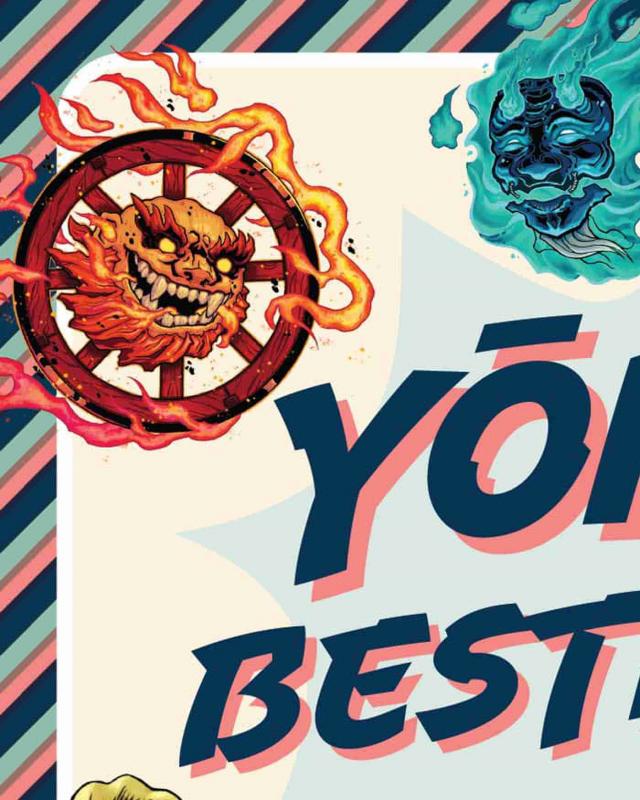
YŌKAI BESTIARY
HOW to DRAW EERIE and ENCHANTING JAPANESE GHOULS and MONSTERS
Lance Red
Introduction
TRICKSTER YŌKAI
Tanuki (たぬき)
Chōchin-obake (ちょうちんおばけ)
Kitsune (きつね)
Bakezōri (ばけぞうり)
Hitotsume-kozō (ひとつめこぞう)
Karakasa-kozō (からかさこぞう)
NATURE & ANIMAL YŌKAI
Kodama (こだま)
Ōgama (おおがま)
Kama-itachi (かまいたち)
Nekomata (ねこまた)
Heikegani (へいけがに)
Shachihoko (しゃちほこ)
Kappa (かっぱ)
Ningyo (にんぎょ)
HOUSEHOLD & EVERYDAY YŌKAI
Biwa-bokuboku (びわぼくぼく)
Shami-chōrō (しゃみちょうろう)
Amabie (あまびえ)
Tōfu-kozō (とうふこぞう)
Rokurokubi (ろくろくび)
Futakuchi-onna (ふたくちおんな)
FRIGHTFUL SPIRITS YŌKAI
Haka-no-hi (はかのひ)
Bakekujira (ばけくじら)
Menreiki (めんれいき)
Sōgen-bi (そうげんび)
Wanyūdō (わにゅうどう)
Ao-andō (あおあんどう)
Yūrei (ゆうれい)
MONSTROUS YŌKAI
Hyaku-me (ひゃくめ)
Kamikiri (かみきり)
Otoroshi (おとろし)
Nure-onna (ぬれおんな)
Ushi-oni (うしおに)
Oni (おに)
Namahage (なまはげ)
Tengu (てんぐ)
Going Further
Acknowledgments/About the Author
Welcome!
In this book I seek to guide you through the drawing of many monstrous yōkai, from the most well-known iconic creatures like the mischievous tanuki to the more frightening oni. Know that the yōkai in this book are but a small portion of the vast variety of yōkai out there. I hope this book helps to captivate your interest in not only yōkai and the folklore around them, but also in Japanese culture, which gave birth to these strange and wonderful creatures. I hope you find inspiration in these pages and are challenged by them to grow your drawing skills.
As you work through each chapter the yōkai are designed to start with the easiest to draw, then progress in difficulty. Though some yōkai may look intimidating, with all the layers of details, take your time working through each step carefully. You can do it. Enjoy the process and know that drawing, like any skill, takes diligence and practice to improve.
Introduction
WHAT ARE YŌKAI?
Bakekujira haunting dark shores, once-cherished heirlooms now neglected coming to life. A glimpse of a fin as a ningyo disappears beneath the waves. Unexplained sounds in the night, glowing wisps of light flitting just at the edge of sight, or that fox watching you from the tree line with deep intelligence in its eyes.
These are all examples of yōkai, creatures from Japanese folklore and tradition. Yōkai exist in the in-between places, where the supernatural meets the everyday, born from the fears and feelings of awe from the Japanese people of the past. In that twilight land where day meets night, life meets death; where the fantastical intrudes upon the mundane: this is where yōkai exist. However, yōkai are not just creatures, but also phenomena, especially earlier yōkai. They served as explanations for mysterious events, such as unexplained sounds, storms, and pestilence. During this early time, yōkai mainly existed in oral tradition and it was not until artists took hold of yōkai that they gained concrete visual forms and became more like creatures.
Many yōkai are born directly from Japanese history and tradition, while others stem from or intersect with religious beliefs (Shintoism, Buddhism). Others still originate from foreign cultures, having been imported from countries such as China or India and adapted into Japanese culture.
YŌKAI PAST & PRESENT
Once the embodiment of peoples’ fears and curiosity, during the Edo period (1603–1868), yōkai began to shift from creatures of fear to entertainment thanks to the work of artists such as Toriyama Sekien. He and other artists began illustrating yōkai for the masses in the form of books and prints. People grabbed hold of yōkai and craved more. In turn, artists began to look at the world around them and imagine, giving birth to more and more yōkai, going beyond the original legends and folklore in order to feed this growing yōkai craze.
Artists gave yōkai visual form, taking them from oral concepts to creatures of comics, spurring on a cultural interest in yōkai that has only grown over the centuries. Even this book is a small piece born forth from this wave of ever-growing interest in yōkai, as foreign artists like myself seek to learn more about them, Japanese culture, and the stories from which they are born.
Today, yōkai are everywhere in Japanese culture. They serve as a deep well of inspiration for artists and other creators. Many of the creatures and monsters you see in anime, manga, and Japanese video games are inspired in some way by yōkai, further spurring on international interest in these bizarre and astounding creatures.
YŌKAI AND MY OWN ARTIST JOURNEY
I’ve been interested in and a part of Asian culture all my life, growing up in a Filipino American household. In middle school, I had the opportunity to travel to Japan when my aunt took me along on a trip one summer to visit our family in Tokyo, who had emigrated there from the Philippines. It was during this trip that I fell in love with Japanese culture. For a month we visited temples, districts in Tokyo, museums, and the countryside. In high school I went on to study Japanese. Now, as a fantasy artist working in the gaming field, many of the projects I have worked on have been based on Tolkien-esque fantasy rooted in European folklore and culture. So, in my personal art I love diving into Japanese yōkai with all their unique forms and diverse stories; it offers a whole new world of visually unique creatures to explore.
CATEGORY AND REGIONAL VARIATION
The categories used in this book are a tool to help make the vast world of the yōkai more approachable and easier to understand. Many of the yōkai shown in these pages could be placed in multiple categories. So, please do not take these as writ for how to organize the vast pantheon of yōkai, but more like guideposts for the content of this book.
Yōkai vary from region to region, village to village, story to story. For example, the famous kappa yōkai has numerous variations throughout Japan. So, know that the forms presented in this book are more general interpretations and that should your interest be piqued, there is much more to discover.
TOOLS & MATERIALS
Here are the tools and materials I use in my studio on a daily basis when drawing: the workhorses of my art practice. Before we dive in, I want to note that not all of these are needed. When it comes to drawing, you essentially just need something to make a mark on a surface and a surface to mark upon. That is one of the beauties of drawing. At its core it is a straightforward, expressive experience.
IN MY STUDIO
Pencils
Mechanical pencil: The main pencil I use is the Staedtler 925, 0.5 mm. It has great weight, so it feels nice in the hand to hold—not too heavy nor too light. I have multiple versions of this pencil, each with a different lead weight. I use 2H to start a drawing (if I’m not using Col-Erase pencils, see below), HB for the final lines, and sometimes 2B if I need to go darker.
Col-Erase colored pencil: These are soft, erasable, colored pencils. I enjoy using these sometimes during the initial block-in stages of a drawing because I find I am able to be a little more loose and free-flowing with them.
Other Pencil Options
General’s Drawing Pencils (2H, HB, 2B): These are fantastic, straightforward drawing pencils, and are great alternatives to the Staedtler pencils.
2mm lead holder (2H, HB, 2B): I used this as my main drawing tool for years before switching to mechanical pencils. You can attain a sharp, fine point on these by using a lead pointer. The main reason I switched is that I grew tired of having to sharpen my pencil all the time in a single drawing session. Still awesome to use.
Blackwing pencils: These have a nice, wonderful soft lead that allows you to draw from very light to very dark depending on the pressure you apply. Sometimes I get in the mood to draw with a traditional pencil and these Blackwing pencils are one of my go-tos.
Drawing Board
This is a giant clipboard for drawing. I like these because I am constantly rotating my drawing as I work, and by placing it on a drawing board I can rotate the board without having to touch my actual drawing. This helps to protect my drawing from any smudging as I work on it. Smudging equals the death of drawing! One must keep the white areas clean! Habits drilled into me from back in my drafting days.
Pencil Sharpener
I am not too particular here. There are the crank kind with a handle, electric sharpeners, or the small, cheap, plastic handheld ones. I use all of them. It just needs to be sharp.
Erasers
Kneaded erasers: These rubbery, bendy erasers are great for lightening lines that you may have drawn too dark, but do not want to erase completely.
Pen-style erasers: These are perfect for precision-detail erasing, as you can hold them like a pencil. My current favorite is the Tombow MONO Zero eraser, as it has a very fine point compared to other erasers.
White plastic block erasers: Block erasers are great for fully erasing large areas. The erasers on the Blackwing pencils are similar, just smaller.
Eraser shields: If you want to be really cool, eraser shields are great if you do detailed drawings. They work well in isolating only what you want to erase, while protecting the rest of a drawing. Eraser shields work best in conjunction with a block eraser; with newer, smaller pen-style erasers they may be unneeded.
Paper
Printer paper: Since you are probably still in the learning phase of your artist journey, you do not need anything fancy. In fact, back in art school this was the go-to drawing paper for students.
Smooth bristol paper: However, for more finished drawings, the best, most wonderful, heavenly paper in the world is smooth bristol, in particular comic smooth bristol. I hate having to fight with paper texture when drawing tight details and this paper is glass smooth.
A NOTE ON DIGITAL MATERIALS
If you are drawing digitally, I would recommend that you practice traditionally too, as being able to manipulate physical drawing tools will increase your overall skill even more. I find the better I get traditionally, the better I get digitally.
My digital drawing setup consists of:
iPad Pro (as big as I possibly can get—the 12.9”, or 327 mm, model)
Apple Pencil and full-screen protector with just a slight tooth/texture to it
Drawing glove
Procreate app
Your favorite digital drawing brush
DRAWING TIPS
I’ll start with the single most important piece of art advice I have received in my career thus far. I was at IlluxCon, a traditional fantasy art show focused on Imaginative Realism, as a young professional. At the time, I enjoyed making art, but having been trained as a commercial artist, to me, art was all about making assets for products. I humbly approached one of my favorite artists in the fantasy art field, Steve Prescott, who makes incredible illustrations. His work has beautiful linework, bold graphic shading, expressive strokes, and characters that feel alive: the whole shebang. I asked him for his #1 tip for making art. I was expecting perhaps a certain technique, maybe a particular process or studio practice, but he gave me two words:
This may sound trite or too simple, but for me, at the time, I was so focused on the work side of being an artist—clients, deadlines, portfolio updates—that “fun” was not even on my radar. I remember thinking to myself, “Is that even allowed?” He went on to explain (I’m paraphrasing here): “We make fantasy art for books, games, and people’s homes. If we aren’t having fun, it will show through our work, and our viewers won’t have any fun when viewing our art. If you are not having fun making art, what’s the point? There are better, easier ways to make money out there.”
Boom! Mind blown.
So, I pass this sage wisdom on to you: “Have fun.” Give yourself permission to make bad drawings. It does not have to be perfect because we are still learning and growing.
DRAWING TIPS
Here are a few drawing tips and techniques to keep in mind and practice incorporating as you work through this book.
Start drawing lightly. The initial lines in a drawing are just the foundation upon which we will build the finished drawing and not the final lines that people will see. So they should be light and erasable.
Draw with confidence (no hairy lines). Many early artists draw lines with a seesaw motion going back and forth because they are not confident they can draw the line with one stroke. Go for it and throw that line! You can always erase if you need to.
Use your whole arm. Bouncing off the previous technique, another bad drawing habit is to draw while only bending at your wrist. While it may seem to give you more control, that is only because you probably have not practiced enough drawing using your whole arm.
Fill the page. Aim to fill the whole page with your drawing. Be brave, draw BIG!
Follow the order of steps. Outside to inside. Big to small. General to specific. This is the usual order when working on a drawing. Start with the largest shape and work toward the center or focal point of a figure. For example, draw in the shape of the head before adding in the features.
Note repeating shapes. In many of these drawings we will be working through, you will be using what are called repeating shapes, which help to simplify more complex designs. It is an artistic trick to break a larger, more complex image into smaller, similar pieces and redrawing them so we can create a visual shorthand. An example of this would be when drawing the vertebrae of the bakekujira or the eyes on the hyaku-me.
Read and research. This book is just a toe-dip into the wonderful world of yōkai and drawing. Don’t stop here. Dive into Japanese culture: Read about the country’s mythology, history, and folklore. Go read all you can on whatever interests you. Fill your creative well so that you have more to draw on when you need ideas. One of my favorite parts about being an artist is that I am always researching and learning about new things!
HOW TO USE THIS BOOK
I touched on this already, but it bears repeating: When learning to draw, give yourself permission to fail and grow. Not every drawing you make will be a masterpiece, and that is okay. Let’s have fun learning to draw yōkai! At first you may want to follow my steps exactly as I have drawn them, but as you build your skills, feel more confident, and learn more about yōkai, I encourage you to try adding your own twist. Maybe it’s new poses or perhaps a different variation of a yōkai (of which there are many, depending on the region of Japan the yōkai originates from or the story it is pulled from).
Drawing Process Overview
The yōkai drawings in this book are broken down into multiple steps. Here is the general art process you should follow when working your way through these steps. These are not set-in-stone absolutisms to follow, but guiding thoughts on what to focus on during each stage of the drawing process. You will also notice that each step is broken down with purpose to effectively build on what came before. We do not begin with the final linework, but instead work our way up to it through multiple passes, building up the basic shapes of the yōkai before drawing in the final line and details.
Foundation for the Drawing
In this first step we will draw the main line of action. A line of action is a single line that captures the general flow of the pose for a given figure. We are boiling down the action of a character into a single gesture, a single line. On this line we will then place the major shapes of the figure, usually starting with the basic head shape and center lines for the facial features.
Basic Shape and Structure
Think of this stage as hanging the skeleton on the line of action upon which we will construct the rest of the drawing. We will simplify the major forms of the figure into basic shapes.
Refined Outlines and Secondary Forms
With the major shapes established, we now start to render the actual forms of the figure, turning the basic shapes into actual limbs and costume, starting with the outlines. Working outside to inside, we will add in the secondary forms, like facial features, to already-drawn head shapes.
The Yōkai Comes to Life
Now we will start to turn the shapes we have been drawing into a character by adding in textures, expression, and details. Having established the forms of the character, now we go inside to draw the details, turning a generic grouping of shapes into a specific character. It is also at this stage that we can erase the guidelines we used at the beginning of our drawing.






