

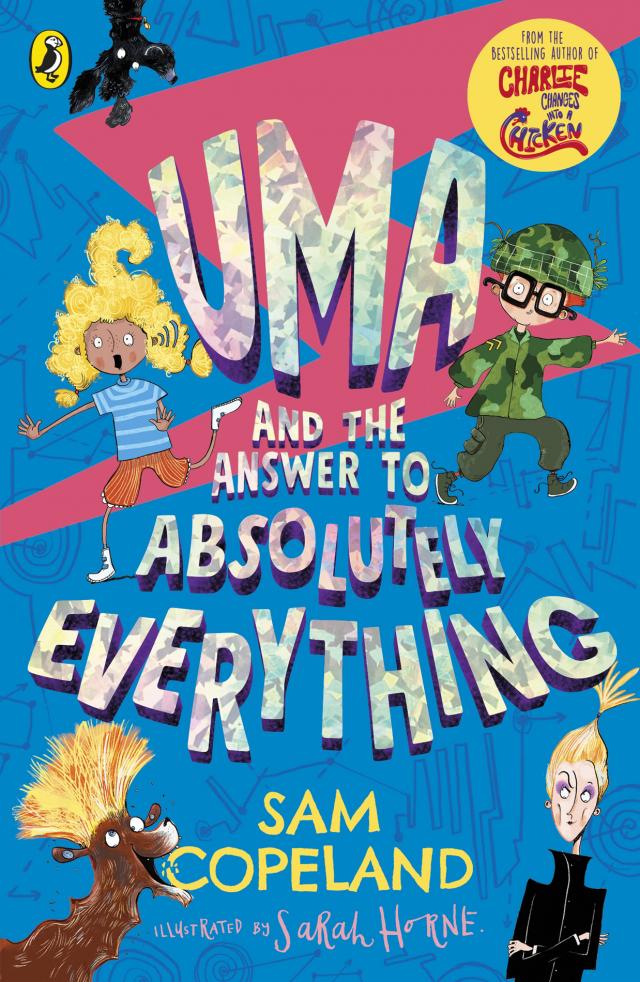
Uma and the answer to ab.., p.1
Uma and the Answer to Absolutely Everything, page 1


Contents
1. The Silent House
2. An Honourable Retreat
3. The First Question
4. ‘Athena, What’s the Best Way to Get Rid of Earwax?’
5. ‘Athena, What’s the Worst Hiding Place Ever?’
6. ‘Athena, How Do You Clean Spray Paint off a Goat?’
7. ‘Athena, What’s the Scariest Question?’
8. ‘Athena, How Do You Unjam a Granny from a Window?’
9. ‘Athena, What’s the Quickest Way to Put Out an Eyebrow Fire?’
10. ‘Athena, Are You Alive?’
11. ‘Athena, Can Dogs Feel Embarrassed?’
12. ‘Athena, What’s the Worst Possible Thing to Crash a Bike Into?’
13. ‘Athena, What’s the Best Way to Get Rid of the Smell of Alpaca Vomit?’
14. ‘Athena, Is It Possible to Pretend a Kiss Never Happened?’
15. ‘Athena, Does Sadness Last Forever?’
16. ‘Athena, Is There Anywhere Colder than the Freezer Aisle at Sainsbury’s?’
17. The Final Question
About the Author
Sam Copeland is an author, which has come as something of a surprise to him. He is from Manchester and now lives in London with two smelly cats, three smelly children and one relatively clean-smelling wife. He is the author of the bestselling Charlie Changes Into a Chicken, which was shortlisted for the Waterstones Children’s Book Prize and spawned two sequels, Charlie Turns Into a T-Rex and Charlie Morphs Into a Mammoth. Despite legal threats, he refuses to stop writing.
Follow Sam online:
www.sam-copeland.com
@stubbleagent
#UmaAnswer
About the Illustrator
Sarah Horne learned to draw whilst trying to explain her reasoning for an elaborate haircut at the age of nine. An illustrator for over fifteen years, she started her illustration career working for newspapers such as the Guardian and the Independent On Sunday.
Sarah has since illustrated many funny young fiction titles and loves to include hilarious details in her work. She works traditionally with a dip pen and Indian ink, and finishes the work digitally. When not at her desk, Sarah loves running, painting, photography, cooking, film, and a good stomp up a hill.
sarahhorne.studio
@sarahbhorne9
Other titles by
CHARLIE CHANGES INTO A CHICKEN
CHARLIE TURNS INTO A T-REX
CHARLIE MORPHS INTO A MAMMOTH
I dedicate this book to myself, Sam Copeland, who, despite the never-ending demands on his time from countless ungrateful sources, has managed to produce yet another literary classic.
The first thing I need to tell you is that I’m not like the heroes you might have read about in other stories. Those children are born to be special, with prophecies and destinies and magical powers. I am not one of those. I am normal at the beginning of the story, and I am normal at the end.
I was just lucky. And anybody can be lucky.
My name is Uma Gnudersonn and I am the narrator of this book. I don’t have much of an imagination, and I’ve always struggled in English lessons to think up clever, twisting stories with wild plots and weird characters, so I’m going to have to tell you a real-life story.
And what I’m about to tell you is completely, one hundred per cent true. Anyone who knows me says I’m the most honest person they’ve met. Apart from when I lie. But I only ever do that for good reason, so you have to believe everything I say. Nothing like what happened to me will ever take place again and that’s why this book is not only the first book I’ve ever narrated but will also be the last.
Let me tell you something about myself to start with because I am the main character in this story so there’s simply no avoiding it.
Firstly, the ‘G’ in my surname is not silent. Just so you don’t get it wrong the whole time, my name is pronounced Ooma Grrr-noo-der-son. My dad is half-Indian and half-Swedish and that’s why I have such an unusual name. My dad also has the bushiest caterpillar eyebrows in the whole world, and hair coming out of his ears.
Lexie Ramblin says my ears are so big they make me look like a gigantic football trophy but she’s the meanest, most horrible girl in the whole of Tylney-on-Sea. She leads a gang of bullies who make everyone’s life at school a misery, so I just try and ignore her. I think my eyebrows are quite normal.
I’m top of my year group for vocabulary because I read so many books, and every time I find a new word I put it in my own personal dictionary that I’ve been writing.
I’m not top of the year group for having friends.
I sometimes wonder if writing my own dictionary and not having many friends might be connected in some way.
My hair is blonde with very tight curls and so thick I can hide things in it. Seriously – sweets, rubbers, everything. Except silly putty. Now that was a bad experiment. My dad was hacking it out of my hair for days …
I’m going to start my story on the day that FOUR exciting things happened. To create tension and build anticipation, I shall tell you about them in order of excitement:
1. Not That Exciting: School finished for summer. When the bell rang, I ran outside as quickly as possible, trying to avoid Lexie and her gang, which is when the second thing happened …
2. Quite Exciting: On the way to the playground, Madeleine Gilligan was sick all over the back of Lexie’s head. Now, I know I shouldn’t have laughed at that, but Lexie had just made up a new nickname for me (Ohmy Gnudiebum, in case you were wondering, which in my opinion was not that clever a name, really), so I don’t feel too bad about it.
3. Really Exciting: When I got home, who was there to greet me but good old Alan Alan Carrington!fn1 Alan Alan is my best friend in the whole village. He lives next door but he goes away to boarding school each term and I couldn’t have been happier that he was back for the summer holidays. He’s my age, a bit smaller than me, wears glasses (which makes him look clever) and likes inventing really cool things. And he always seems to have the answers to whatever questions I can think of – and I have lots of questions. For instance, questions I have thought about just today are:
Why do old people shrink?
What’s the most disgusting animal in the world?fn2
How do I stop bullies?
If I could eat myself, would I get twice as big or would I disappear?
Are my ears closer to me or are my feet closer to me?
Anyway, all my life, Alan Alan has said he’s the cleverest person ever. It was him who taught me all the capitals of the world, like how Paris is the capital of France, Rome is the capital of Italy and Bratwurst is the capital of Germany. He taught me that running in your slippers makes you go ten per cent faster and that’s why slippers were banned from the Olympics, and that goats are actually baby llamas.
As well as being the cleverest person in the world, he’s also the bravest. For instance, last summer we were at his house and a wasp flew in through the window. I was terrified but Alan Alan bravely opened the door and ran out screaming and waving his hands in the air. Unfortunately this didn’t lure the wasp away from me, as he said afterwards had been his plan. Eventually the wasp flew back out of the window, and when I shouted to Alan Alan, telling him the wasp had gone, he ran straight back in to check I was OK.
Well, anyway, I thought he was the bravest and the cleverest person in the world until I found out he was actually quite the opposite, as you will see later. I suspect the whole wearing-glasses thing was merely a disguise. He certainly had me fooled. And now I’m not sure about any of the capitals of the world.
4. The Most Exciting: I found the thing that changed my life, the fate of the whole village and everything – and it all started with a drunk alpaca.fn3
I shall come to that shortly, but first I need to jump back to Alan Alan Carrington because he was with me when the Most Exciting Thing happened.
* * *
As usual, when I got home from school the house was completely silent. My house was almost always silent: my dad had hardly spoken since Mum died, we didn’t have a television, and we never had music or the radio playing.
We had been a musical family once and the house always used to be filled with the sound of the violin, which my mum taught. When she played, the sound swept and echoed through the house, flying from room to room like a bird, and wherever I was I closed my eyes and my heart soared. My dad would join in with his tabla or even guitar sometimes. I was learning the flute and had got quite good. When we played together, my dad would whoop and stamp his foot, and I would giggle, and Mum would lead us with her violin, pulling us all along in something that resembled harmony.
The guitar and violin now sat in their cases, untouched and unused. Every so often, I would take the violin out and run my fingers over the wood, where it used to rest in the crook of Mum’s neck, asking myself the same question again and again: the question with no answer.
I didn’t practise the flute any more.
Nobody visited us either and I don’t blame them, to be honest. The only two noises you heard in our house were the echoing sound of footsteps on the wooden floors and the occasional buzz of a little electric train.
Dad had always loved model trains. Mum let him build a track in the basement, even though she wanted to turn it into a music practice room. But after she died the track began to grow unchecked. It started to creep its way out of the basement, across the hall, up the stairs, and its rails now stretched through the whole house, snaking in and out of every room, under chairs, over tables, weaving among the dead plants. And dead plants were everywhere in our house – and I mean everywhere: on windowsills, on tables, on shelves. Dead ivy clung to the walls. My dad had forgotten to water them after Mum died and so now we lived in a wildnerness of dried, dead plants and a tangle of OO railway tracks.
Along the tracks, Dad had built a scale model of Tylney-on-Sea: the Obelisk on top of Beggar’s Hill, the Church of St Mary in the centre of the village, all the houses and shops, the station and the pub, and people with hands stuck forever in the air, waiting to wave as the train whizzed by. In fact, when I walked in, Dad was at the kitchen table, hunched over, painting a tiny model of our postperson.
‘Hi, Dad!’ I said brightly. ‘School’s finished for the summer!’
I stood waiting for a moment, hoping for a reply, even though I knew I wouldn’t get one. ‘Daaad,’ I continued, ‘do you know why humans aren’t covered in fur like monkeys?’
I was used to Dad not answering my questions now. He always used to answer everything – he was even cleverer than Alan Alan.
The heavy silence made my throat tighten.
Finally, my dad looked up from his painting, brush in hand, and peered at me over his glasses, almost like he was about to speak. He was always almost speaking but he never did.
Dad didn’t stop speaking immediately after Mum died. It was a slow process. Straight afterwards he shrank inside himself a bit but he still spoke in short sentences.
He only stopped completely after I asked why Mum had left us.
You see, a few months before she died, she’d just walked out. She didn’t even say goodbye, although she left Dad and me each a note. I’ve still got mine. It’s been scrumpled a bit, Sellotaped where I tore it into pieces once, and the ink is pretty smudged now, but I still have it in a box under my bed. Every so often I get it out and read it, and the ink gets a little more faded.
After she died, Dad took down all the photos of Mum and put them in a suitcase in the basement, along with all her clothes and jewellery. It was like she had never existed. But I still remember her hooting laughter ringing round the house, such a big laugh for a small person. I still remember her roaring ‘No, no, no! I said vibrato!’ at the hapless school children who trooped in weekly for lessons. I still remember sitting at the top of the stairs, peering down through the bannister and watching her talk at dinner parties, her arm draped round Dad. She was always the noisiest person at the table. After dinner, Dad would get his pipe out, the smell of woody smoke drifting up to the landing. I still remember the feel of Mum tucking me in at night, pushing and squashing the duvet in all around me. The touch of her lips on my forehead.
I still remember.
When I asked Dad why she left us, I could see panic etched across his face. His mouth flapped like a fish on the deck of a boat. He looked like he was trying to speak but no words came out. Eventually he stopped trying, his mouth slowly stopped moving and, at that moment, what light there was left in his eyes died completely.
That’s when my dad disappeared into himself. And I never did find out why Mum left.
Boo-hoo-hoo – pretty sad, right?
A knock on the front door shattered the silence, and we both jumped.
I ran to open it and there, grinning from ear-to-ear, and for some reason dressed from top to toe in army camouflage, was Alan Alan Carrington.
And, boy, was I pleased to see him?fn4 Alan Alan was holding on to a lead and attached to the lead was Dolly Barkon, a great big, black, curly-haired labradoodle that lived next door with Alan Alan and his two dads, Richard and Ed.
‘Dolly, go and say hello!’ Alan Alan said, and Dolly bounded forward and jumped on me, knocking me flying. Once I managed to stop her licking my face, I pushed her off, sprang up and gave Alan Alan a ginormous bear hug.
‘So what’s with all the army gear?’ I said, grinning.
‘Just in case …’ he replied, nodding mysteriously.
‘In case of what?’
Alan Alan put his hands on my shoulders. ‘It’s best you don’t know.’
I had forgotten that Alan Alan was really into conspiracy theories. He was always rattling on about bodysnatching monsters, mind-controlling radio waves or buried treasure in the village. His most recent theory was that the government was stealing our hair to make … I can’t actually remember what. I think it was wigs to allow bald aliens to blend in with humans but I’m not sure – there are so many of his theories, I get them mixed up.
‘And, anyway, the army have sworn me to secrecy,’ Alan Alan said gravely.
‘The army?’ I asked a little suspiciously.
Alan Alan ignored my question and marched into the house. We found my dad crouched over his painting again, deep in concentration.
‘Good afternoon, sir!’ Alan Alan barked.
My dad jumped and dropped the model he was painting, which knocked a glass of water over. Dad turned and glared at Alan Alan, who was giving a sharp salute.
‘Dad, is it OK if me and Alan Alan take Dolly for a walk and go look at the horses?’ I asked.
Dad grunted and started mopping up the mess.
A grunt was my father’s preferred answer to most questions, and I had learned to decipher their meanings quite accurately. This was his Fine, just don’t bother me grunt.
To check that he was actually listening, I asked him another question.
‘Dad, is it OK if we go to a wild party with rodeo sheep-riding too?’
My dad gave the same Fine, just don’t bother me grunt.
Anger flashed through me. Typical. As usual, Dad’s mind was somewhere else.
‘OK, bye!’ I said.
My dad did his Goodbye grunt in reply.
I saw Alan Alan steal a glance at me and couldn’t help notice the look of pity in his eyes. I hate people pitying me. And I have had a lot of that since Mum died. But that’s actually helpful for this book because Miss Moore, my English teacher, told me that tragedy is very useful in a story, ‘to get empathy from the reader’. Well, I hope you’re full of empathy.
‘Right,’ said Alan Alan. ‘Where’s the wild party? I’ve never been sheep-riding before! How exciting!’
He looked crestfallen when I broke it to him that we weren’t actually going sheep-riding.
‘So what are we going to do then?’ he said. ‘Hunt for Bigfoot? Or we could go look for the Tylney Treasure? I have some hot new leads and a second-hand metal detector.’
You see, Alan Alan was always going on about loopy stuff like this. He swore that he had seen Bigfoot once in the woods outside the village but here’s the thing – Alan Alan wasn’t well known for telling the truth. It wasn’t that he was a liar exactly, it was just that sometimes he made stuff up. For instance, a few years ago, there was Poolgate.
It had been a hot summer’s day and we had the paddling pool out in my back garden. We were squirting each other with water pistols and laughing and screaming, when I looked down and screamed properly.
‘What is that?’ I yelled, pointing at what looked suspiciously like a poo floating in the pool.
‘What?’ asked Alan Alan, his face a picture of innocence.
‘THAT!’ I pointed again. ‘It’s a poo!’
Now a normal person might confess and make an excuse or apologize. But not Alan Alan. What he said was:
‘Oh, that! A squirrel did it.’
‘A what did you say?’
I jumped out of the paddling pool, thinking I should have got out about twenty-five seconds earlier.
‘A squirrel did it. When you were busy filling the water pistols, it jumped in and did a poo in the pool.’
‘WELL, IF YOU SAW A SQUIRREL JUMP IN THE POOL AND POO IN IT, WHY ON EARTH DID YOU JUST KEEP ON PLAYING IN HERE?’
The older you get in life, the more you start to realize some questions have no answers. And this was one of them.
So, you see, Alan Alan’s relationship with the truth was complicated. He promised he had seen ghosts and aliens and all sorts – none of it was true. And he promised that Old Mr McIntosh had told him everything about the Tylney Treasure, this secret treasure that was meant to be buried somewhere in the village. But even if Old Mr McIntosh had told him anything – which I highly doubted – Old Mr McIntosh kept getting kicked out of Sainsbury’s for going in to do his weekly shop wearing nothing but his underpants, so would you trust him …? Exactly.






