Xeelee 47 gravity dreams, p.1
Xeelee 47-Gravity Dreams, page 1
part #47 of Xeelee Series


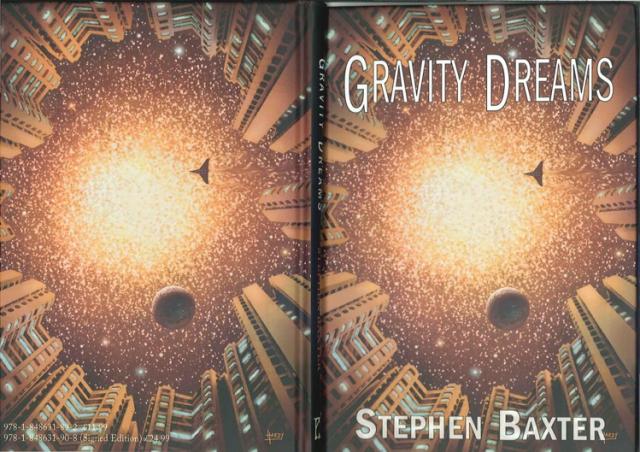
GRAVITY DREAMS
GRAVITY DREAMS
INTRODUCTION
This novella is published precisely twenty years after the appearance of my first novel, Raft-though to me, of course, it seems like yesterday.
The novel grew out of a short story of the same title, first published in September 1989 in the invaluable and essential British sf magazine Interzone (issue no. 31). 'Raft' was set in my 'Xeelee Sequence' universe, which had originated in my first professional sales to Interzone. The Sequence is a saga of mankind's deep future in the Galaxy, and our conflict with the enigmatic and all-powerful alien race the Xeelee. The idea for the short story itself came from a throwaway piece of science speculation I read somewhere on the fine-tuning of physical parameters in our universe. If gravity were a little stronger, stars would be smaller and would burn out more quickly...The result was a story of a human starship crew cast away for generations in a universe where the force of gravity is a billion times stronger than it is here, and the wreckage of their craft, adrift in nebular air, is the raft of the title.
In those days I was still a greenhorn and not fully in control of the material (in as much as I ever have been in control, that is). This was of course always too big an idea to cram into a short story; I had to wrestle the piece down from 10,000-word early drafts. And even after it was published in Interzone, my mind wouldn't let go of the scenario, coming up with fresh wrinkles on the central conceit.
Around the same time I was angling for a first book publication. I'd tried to follow the example of my very good friend Eric Brown, another scion of the 'Interzone generation' of those days, in placing a collection of short stories, but was advised to try pitching a novel instead. And when I started to think about a subject for a first novel the universe of 'Raft' was an obvious place to return to. I already had the bones of a story to tell, a universe I'd begun to explore, characters I'd begun to write about. The earlier story, included in this volume, ended up as a very rough sketch of the eventual novel (This novella is a sequel to the novel rather than the story.)
Raft was first published by Grafton (HarperCollins) in July 1991 (and republished more recently in a compilation of four novels called A Xeelee Omnibus (Gollancz, 2010).) My first book was dedicated to my wife, Sandra, who has remained my essential support in all my subsequent adventures and misadventures. I'd also like to take this opportunity to thank Malcolm Edwards and Chris Schelling, who bought the book respectively for Grafton and Penguin Roc, thus kickstarting my career internationally-and I'm delighted still to be working with both of them.
Raft was set some hundred thousand years after the present, with mankind at war with the Xeelee across our Galaxy and others. Gravity Dreams is set nearly a million years after the present, with the war lost and mankind retreating-and yet haunted by the relics of conflicts long past...
Stephen Baxter Northumberland, England January 2011
AD 978,225
1
‘Massive sensor dysfunction!’
This time his own shout dragged Coton out of his dreams. He lay on his pallet, gasping, sweat coating his face.
Here was his grandmother, Vala, in her night robe, her round, calm face shadowed in the glow cast by a single hovering light globe. Above him loomed her house, a tetrahedron of metal bars and panels hung with musty tapestries, cosy and cluttered and mundane. 'It's all right. You were dreaming. You woke yourself up.'
'And you. I'm sorry.'
'Don't be.' She sat on his pallet and passed her hand over his brow, and her fingertip traced the tattoo there, an inverted black tetrahedron, like her own. 'It's why you came here, in a way. So I can help you cope with the nightmares.'
'But it wasn't like my other dreams.' He'd had plenty of nightmares of flight. It was only a month since the ships of the Second Coalition had appeared in the skies of Centre, and the officials and the troops had landed to impose their curfews and tithes and evacuations—and the population, enraged, had turned in on itself, and Weaponised families like Coton's had become targets of hate and frustration. Only a month since he'd had to abandon his parents, and his world, at the age of seventeen.
'But this was different.' He clenched his fists and huddled them into his chest. 'I couldn't move. As if my arms and legs had been cut off. I could see and hear, but there was something wrong with my head. I was floating in this big sky, a red sky that was full of glowing shapes, like light globes-or stars. But I hated it, for it was wrong.'
'Wrong?'
'I shouldn't have been there. It was my duty to get everyone out—to get them home. But I couldn't move.' He twisted, as if wrapped up.
She took his hands. 'Take it easy. There could be another cause. Your parents would have explained all this, one day...You know we're Adepts, Coton, don't you? And young Adepts sometimes have dreams we call them gravity dreams. It might be nothing to do with the pogroms back on Centre...But dreams of immobility are common even among normals, I think. These things are subtle, indirect. Your dream could be a sign that you're healing, in some way. The waking mind trying to reconnect with the body.'
'What did I say?'
'When you woke up? Not words I recognised. Mas-eef...Can you replay?'
Coton's own voice came echoing out of the air, the sound shaped by the smart systems that pervaded Vala's environment. 'Massive sensor dysfunction.'
'Doesn't mean anything,' Coton said.
'Perhaps not. The words sound archaic. It might be interesting to check.'
That was like his grandmother, whose scholarship, according to his own mother, had made her a cold parent, and caused them to fall out. Her world, after all, had no name but a number-Delta Seven-and Vala referred to it, not as home, but 'the college'. Now he was stuck here with her, and she was studying his dream as if it was an academic puzzle. He felt a surge of resentment.
He needed to move, to blow away the last dark shreds of his nightmare. He pushed aside the sheets and rolled off his pallet, his bare feet on the cool floor.
'Are you all right?'
'I need some water.'
He shoved his way out through the thick woven flap that was the door of the house, and emerged into cavernous gloom. Lights. A sprinkling of globes lit up and revealed the expanse of this Map Room, the shining floor, the complicated walls with their reefs of shelving, and the alcoves folding off into the dark like suppressed memories.
He made for a bathroom block, a neat cube a hundred paces away. Here there were spigots and low sinks. He bent, and the water, flowing without a command, poured into his mouth, cool and clean.
When he was quenched he stood back, and found himself staring at the spigot.
Vala walked to his side, wrapped in a black cloak, evidently uncertain of his mood. 'You know, that spigot was put here for the scholars who once worked in this chamber. Now the students are long gone. But the spigot itself, the tip of a vast self-maintaining system, doesn't care whose thirst it quenches; it just does its job, millennium after millennium. I'm sure there's a lesson for us all in that... '
He glanced at her shack, sitting squat on the shining floor. 'Long gone?'
'Oh, yes. It's obvious my house is much more recent than the Room itself. When I first moved in I could even see traces of a hearth. Somebody had been building fires, here on the floor of the Map Room. That's how badly things fell apart, when the last unified government collapsed.’
They walked together across the gleaming floor, their voices small in the huge hall. 'What did they study here?'
'You know, you've been here a month, and this is the first time you've shown any real curiosity about this place. I think that's a good sign, don't you?'
But he had no wish to be analysed, and he kept silent until she answered his question.
'The truth is, I'm not sure. The archives have been very badly damaged. The college probably served two main purposes. First it was a branch of the Library of Futures. The architecture is similar to the central Library on Earth.' She waved a hand. 'Once, you know, the air in here, those alcoves and shelves, would have been full of Virtual images of space battles, ships hurling themselves against the enemy in sheaves of unrealised possibilities!'
He barely understood this, but it was a thrilling vision. 'What enemy?'
'The Xeelee, of course. What other enemy is there? As for the second function—if I'm to show you that, you'll have to come outside, just briefly.'
She linked her arm in his, and led him to a walkway that jolted into motion, making Coton stagger. They were swept towards a blank wall at alarming speed. Coton tried not to show his nervousness. All this was grander than anything he was used to on Centre, and more ancient, and he couldn't help wondering what would happen if the power were to choose today to fail. Vala seemed quite unconcerned.
In the very last instant the wall puckered and opened, to reveal a gleaming corridor. The walkway swept them inside, and Coton tried not to flinch. They emerged in the open air, on a parapet that rimmed this cubical building, under a star-filled sky. Coton's bare feet were cold.
He hadn't been outside since he'd been dumped here from the Coalition scow-he did recall it had been night then, always night here on this sunless world—and he only vaguely remembered the landscape. Buildings stood proud all around him, evidently ancient but many of them intact, in rows and crescents and great overlapping circles. It was like a museum of architecture. But, under a sprinkling of light globes, most of the buildings were dark, and here and th ere fires flickered. And between the buildings, though some of the moving walkways evidently still ran, vegetation had broken through the ancient pavement and flourished green and black and purple.
Vala said, 'You must imagine this university—city as it was in its day, when these lanes were full of flitters and ground vehicles, and Commissaries crowded in their black robes. What a sight it must have been! The college was surely a strategic anchor of the Library of Futures, in this corner of the Sagittarius Arm. And the other purpose was—that!' She pointed into the sky.
There was nothing much to be seen where Vala was pointing—but what a sky it was, Coton thought. Stars hung like crimson lanterns before a veil of wispy, glowing gas, where dense knots told of new stars struggling to shine. But behind all that lay a deeper darkness, a profound night that spanned half the sky. That was the signature of the Xeelee—of the Scourge.
'Do you recognise what you're seeing? Which way is Sol, for example?' He jerked his thumb over his shoulder, away from the Scourge darkness. 'That way.'
'Yes. About nine thousand light years away, in fact. Sol is in the next spiral arm out from the centre of the Galaxy-and opposite the Scourge. The Xeelee are only few hundred light years out from us now, and they'll be here in a millennium or so.'
'Not if the Second Coalition can stop them. The Marshals have a plan. The crew told me on the freighter.' She snorted. 'I'd like to hear it...As for the young stars, we're in the Carina Nebula, one of the Galaxy's great stellar nurseries.'
'They won't last long.'
'No. Even the youngest star in the Galaxy is infected by photino birds. And it is the action of the photino birds that was, I believe, the second subject of the college's study.' She pointed again. 'Up there is a neutron star. When it was discovered by astronomers on Earth, it was one of the brightest stars in the Galaxy-as massive as a hundred Sols, and a million times as luminous. Its catalogue number was HD93129A.'
'It must have imploded. A supernova—'
'Yes. But it popped too quickly. The photino birds had tinkered! And under the old Coalition, the college was established here to study how that supernova process differed from the usual, whatever might be strange about the neutron star, and whatever could be learned of the birds themselves.' She smiled, raising her head, and the coal-black tattoo on her forehead glinted in the red starlight. 'What a sky! I sometimes think you can see all of human history summarised from this spot—and our future.'
'So why are you here now? You and those you work with.'
'We're still studying the neutron star-but from a different point of view. We're looking for relics of a later age.'
'Relics?'
'Weaponised. A later government called the Integrality threw a breed of Weaponised humans into neutron stars, so they could turn the stars into engines of war. There are some in our neutron star, we think.'
Weaponised—as Coton was, and his grandmother. 'What will you do when you find them?'
'Try to save them.' She smiled. 'We Weaponised must stick together. There are many of us here—a few Adepts like us, and other kinds on this world—even a few exotic types around the neutron star—'
'Around it?'
'As knots in the magnetic field. When it came to creating human-analogues as weapons of war, the Integrality was nothing if not ingenious. We've organised ourselves for the rescue work; it is a project run by Weaponised for the benefit of Weaponised. No government supports us, and nor would we want it. Some of us consult, trade, research, even farm to support those who do the work; some local populations even pay us a tithe, for they recognise the worth of what we're doing. I'll show you what we're planning for the Starfolk. We've even created a vivarium to hold them, when we retrieve them.'
'A vivarium?'
'A tank of neutron superfluid...The Starfolk are creatures of nuclear forces, Coton, and they scale accordingly. To them we're misty giants.'
He rubbed the inverted-tetrahedron tattoo on his own forehead. 'You know, I've grown up knowing I'm Weaponised. But I never knew what our special skill was supposed to be.'
'It was bred out of us—though some of us still have gravity dreams, when young. It's generally thought best if children don't know. They get into less trouble that way.'
She led him back into the building, along the corridor with its eerily dilating doors, and to the Map Room. 'I know you didn't want to leave home, Coton. But you understand there was no choice.'
'My parents spent all they had keeping me out of the labour colonies. '
'Yes. But now you're here, and there's work to do. What do you think?'
His head whirled, full of new ideas and images and the lingering shadow of his nightmare. 'I think I'm tired.’
She laughed. 'Back to bed for both of us, then. We'll talk more in the morning.' She led him to their tetrahedral shack. He lay down in his pallet. Soon his thoughts were dissolving into sleep.
But he was woken by Vala, outside the shack, murmuring questions. 'Massive sensor dysfunction. Seek possible translations and date the language. And keep the noise down...'
A solemn synthesised voice murmured a reply.
'How old?'
He was next woken by the tumbling crash of supersonic flight, a noise too familiar from Centre. Without dressing, without looking for Vala, impatiently waiting for the walls to open, he rushed out of the building.
The sky was full of Second Coalition warships.
2
‘Massive sensor dysfunction!’
Sometimes Lura thought that if she could only understand that strange complaint of the Mole, she would be able to make much more sense of the machine, her mother's strange bequest. On the other hand, if it just kept quiet she wouldn't have to fret so much about hiding it. Nothing was ever simple!
But right now she had other problems, for her tree wasn't happy. Lura could feel it, even hanging as she was in her fire pod, dangling from the central trunk of Tree Forty-Seven.
She had spent her shift as tree pilot artfully shaping the screen of grey smoke beneath the tree, and so she looked up at it now through billowing, sooty clouds. The tree was a wheel fifty paces across, its twelve radial branches fixed to the stout trunk at the centre, and it turned, ponderously graceful like all of its kind, the light of the endlessly falling stars casting subtle shades and blood-red highlights, and she could feel the downwash created by its shaped branches as they bit into the air. Tree Forty-Seven was at the bottom of the great stack of
the Forest, layer upon layer of straining trees all tethered by their long cables to the kernel far below her-the husk of a burned-out star, no wider than the tree, pocked and hollowed out and rusted the colour of blood.
And she could sense her tree's unhappiness in the faint shudders that rustled those banks of leaves as it turned, and a groan of wood on wood as the massive bolus counterturned within the hollow trunk. She knew what was wrong, but there was nothing she could do about it, not for now.
It was a relief when she heard the whistles and rattles sound all across the Forest, calling the shift change.
Sweating, her bare arms covered in soot, her lungs full of smoke and her eyes gritty, she swarmed up the rope from the fire-pot through her smokescreen. Passing through the blade-like branches, with disturbed skitters spinning up around her, she picked up her pack of rope and food where she had left it hooked on a stubby branchlet.
And she stroked the trunk's hard surface. 'Well, you've a right to be unhappy, Forty-Seven,' she said. 'Stuck down here as you are.' She didn't agree with the Brothers' policy of 'punishing' ill or poorly performing trees by marooning them at the base of the Forest stack—she'd argued over this with Brother Pesten, her own old tutor, many times. The tree had a subtle gravity sense and would be well aware of the pull of the kernel—some five gees down on its surface, and as much as a tenth of a gee here two hundred paces or so up. Trees were creatures of the open air, and sought to flee deep gravity wells—which, of course, was the instinct their human masters exploited to put them to work. Lura, eighteen thousand shifts old, understood that to be unable to escape this deep well for shift after shift was torture for Forty-Seven. So she patted the tree's trunk, and put her cheek to its rugged surface and felt the mass of the bolus spinning in its confinement within. 'I'll see if those idiots in the pilots' conference will allow me to move you—'